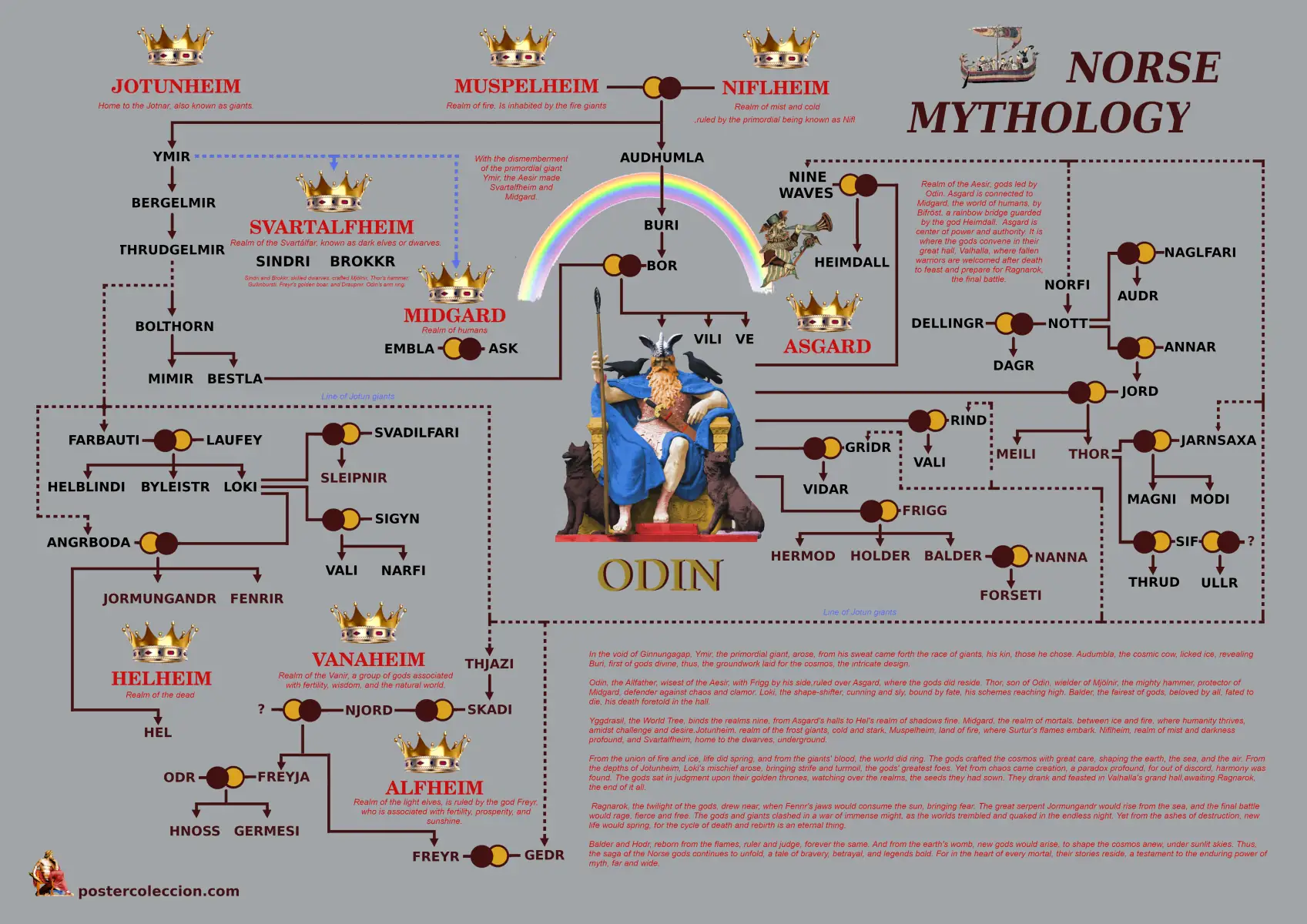

Norse Mythology: Genealogy
An Introduction to the Scandinavian Cosmos
Before becoming an inspiration for novels, video games, and cinema, Norse mythology was a complex oral tradition passed down for centuries by the Scandinavian peoples. Their tales form a complete cosmological system: gods, giants, worlds, and primordial forces interconnected through lineages and rivalries.
Historical Chronology and Sources
These stories began to be transmitted orally among the Germanic peoples of Northern Europe as far back as the Iron Age (1st to 5th centuries AD), later evolving during the Viking Age (8th–11th centuries). However, most of the information available today was compiled much later, primarily in Iceland during the 13th and 14th centuries, following the Christianization of Scandinavia. The most vital sources are:
-
The Poetic Edda: A collection of anonymous poems with ancestral roots.
-
The Prose Edda: Written around the year 1220 by Snorri Sturluson, one of the primary preservers of the Norse mythological tradition.
Cosmology: From Ginnungagap to Ragnarök
Norse cosmology begins with Ginnungagap, the primordial void located between the icy realm of Niflheim and the fiery world of Muspelheim. From the meeting of frost and fire emerged Ymir, the founding giant of the realm of Jotunheim, and Audhumla, the cosmic cow. From her existence emerged the first god of the realm of Asgard, Buri, and subsequently his grandsons Odin, Vili, and Vé. They eventually slew Ymir and used his body to create the cosmos: the earth, the seas, and the mountains.
At the center of this new creation rose Yggdrasil, the immense universal ash tree that sustains the Nine Realms and connects all existence. In addition to the aforementioned realms, there are Midgard (the world of humans), Vanaheim (the realm of the Vanir gods), Alfheim and Svartalfheim (associated with elves and dwarves), and Helheim (the realm of the dead).
The gods of Asgard travel to Midgard via the rainbow bridge, Bifröst, permanently guarded by Heimdall, a watchman capable of hearing grass grow and seeing across vast distances. Beneath the roots of Yggdrasil lie sacred wells linked to knowledge and destiny, most notably Mimir’s Well, from which Odin drank after sacrificing an eye to gain profound insight into the cosmos and the future.
Conflict and the Twilight of the Gods
Norse mythology is defined by unstable alliances and constant conflict between the gods of Asgard and the giants of Jotunheim. While the god Thor protects gods and humans against the forces of chaos, the giant Loki, an ambiguous and shifting figure, fosters confrontation. From Loki were born creatures destined to trigger the end of the cosmic order, such as Fenrir the giant wolf and Jörmungandr, the serpent that encircles the world.
The death of Balder, son of Odin and a symbol of purity, was interpreted as the final omen of Ragnarök: the ultimate battle where gods, giants, and monsters destroy the old world. However, Norse tradition does not end with absolute destruction. After Ragnarök, a new fertile land will emerge, and some gods and humans will survive to begin a new cycle of the world.
The Nine Realms of Yggdrasil:
-
Asgard: Realm of the Aesir gods.
-
Vanaheim: Realm of the Vanir gods.
-
Jotunheim: Realm of the giants.
-
Midgard: Realm of humans.
-
Alfheim: Realm of the Elves.
-
Svartalfheim: Realm of the dwarves.
-
Niflheim: Realm of the frost giants.
-
Muspelheim: Realm of the fire giants.
-
Helheim: Realm of the dead.
Art Print Analysis
This print has been designed as a structured visual representation of the genealogical and cosmological relationships present in Norse mythology. Through a hierarchical system of connections, it illustrates the origins of the gods, giants, and fundamental creatures of the Scandinavian tradition.
The composition gathers the primary figures of the Eddas in a single work, clearly showing the relationships between Odin, Thor, Loki, Freyja, Heimdall, Balder, Fenrir, Jörmungandr, and other central characters. In addition to family lineages, the print incorporates essential cosmological elements like Yggdrasil and Bifröst, facilitating a global understanding of the Norse universe.
Artist’s Note: Due to the fragmentary nature of medieval sources, this organization faithfully follows the structure described in the fundamental texts: the Poetic Edda and the Prose Edda.
Video Analysis by the Author (Please note: The video is in Spanish. You can enable English subtitles in the YouTube settings icon ⚙️).
Technical Specifications & Quality
-
Print: High-definition Giclée print on archival-grade matte art paper.
-
Design: Hierarchical structure optimized for readability and academic study.
-
Size: A2 Format (16.5 x 23.4 in / 42.0 x 59.4 cm).
-
Shipping: Safely delivered in a high-resistance protective cardboard tube.
-
(Frame not included).
This print is the most comprehensive Norse mythology family tree designed for both scholarly study and fine decor.

Valoraciones
No hay valoraciones aún.